From Shaffer Grant to Series A: An Update on Tavo Therapeutics’ Journey to Advance Glaucoma Care
Tavo was built on technology developed by Monica Jablonski, PhD, a Professor at the University of Tennessee Health Science Center (UTHSC) and a 2018 GRF Shaffer Grant Recipient.
Clinical-stage biotechnology company Tavo Therapeutics recently announced the successful closing of a $17 million Series A financing round. Led by Pureos Bioventures, with participation from Polaris Partners and Tau Capital, the funding will be used to advance Tavo’s pipeline of novel therapies targeting glaucoma and retinal disease.
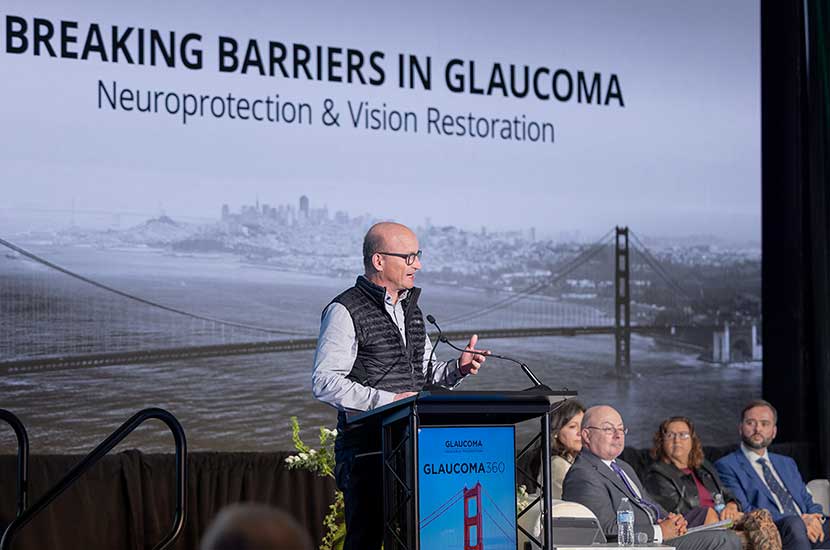
This milestone comes on the heels of Tavo’s presentation at the Glaucoma Research Foundation’s (GRF) annual New Horizons Forum earlier this year.
The company’s origins are closely linked to GRF; Tavo was built on technology developed by Monica Jablonski, PhD, a Professor at the University of Tennessee Health Science Center (UTHSC) and a 2018 GRF Shaffer Grant Recipient.

Early Development and the GRF Catalyst
Dr. Jablonski founded OculoTherapy in 2013 to address a persistent challenge in glaucoma management: patient compliance and the limitations of traditional eye drops, which require frequent dosing and often cause fluctuating intraocular pressure (IOP).
To solve this, she engineered an extended-release, once-daily topical microemulsion-based formulation. The design includes a bioadhesive component that extends the medication’s contact time with the cornea, allowing for a gradual, sustained release capable of maintaining a lower IOP for at least 24 hours.
In 2018, Dr. Jablonski received the GRF Shaffer Grant, which provided critical early-stage support to further develop this formulation for commercialization. This initial research served as a springboard, enabling her to subsequently secure three federal Phase 1 Small Business Innovation Research (SBIR) grants, a Phase 2 SBIR grant, and an R24 translational research grant from the National Eye Institute to advance the platform.
The Science: A Comprehensive Approach to Glaucoma
Officially launched as Tavo Therapeutics in 2024, the company is now moving Dr. Jablonski’s discoveries through the clinical pipeline. At the 2026 New Horizons Forum, Tavo shared data on its lead program, TAV-001, a topical eye drop designed to offer a more comprehensive treatment for glaucoma by targeting the autonomic nervous system – which plays important roles in maintaining IOP as well as helping to mediate blood pressure through vessel constriction and inflammation.
TAV-001 works by inhibiting alpha-2-delta, a protein subunit of calcium channels encoded by the CACNA2D gene. By blocking this target, TAV-001 may have three distinct mechanisms of action against glaucoma:
- IOP Reduction: In both high-pressure and normotensive models, TAV-001 demonstrated a 30% reduction in IOP after a single dose, outperforming standard control options like latanoprost.
- Reduced episcleral venous pressure (EVP): EVP is often referred to as the “floor” of IOP because traditional glaucoma treatments can only lower pressure to this level, but not below it. Researchers believe that TAV-001 can lower EVP as a result of decreased vessel constriction, which increases blood perfusion and oxygen delivery to the retina—a critical factor for all glaucoma patients.
- Neuroprotection: Glaucoma often promotes inflammation within the retina (called “neuroinflammation”) and leads to an increased number of reactive cell types while decreasing the number of protective cell types. Preclinical data from Tavo showed that TAV-001 helps restore this balance, protecting retinal ganglion cells and preserving vision.
Current Clinical Milestones and Next Steps
Backed by the new $17 million in capital, Tavo Therapeutics is actively advancing its clinical pipeline:
- Phase 1b Study: Tavo is currently conducting a Phase 1b dose-escalation clinical study of TAV-001 in patients with primary open-angle glaucoma, using latanoprost as its comparator. Topline results from this study are expected this summer, which will provide a clear framework for future Phase 3 trials.
- Pipeline Expansion: The funding will also support IND-enabling activities for TAV-002, a potential first-in-class treatment for retinal diseases including diabetic retinopathy, diabetic macular edema, and both wet and dry age-related macular degeneration (AMD).
The transition of Dr. Jablonski’s research from an early-stage academic project to a venture-backed, clinical-stage company highlights the trajectory of Shaffer Award-funded projects, demonstrating how early feasibility studies mature into advanced therapies for blinding disorders.
Article by Cynthia Steel, PhD, MBA, Chief Scientific Officer for Glaucoma Research Foundation.